The Brown Bin
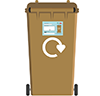
The brown bin is used to collect garden waste. The contents of the brown bin goes to be processed into compost.

Click in the box above and select the item you wish to check or type the name of the item. Once you have selected an item click search, it will then tell you which container that item needs to go in.
IMPORTANT: PLEASE ENSURE THAT LIDS ARE FULLY CLOSED on all bins and they are not over filled.
Unfortunately Biffa will not empty a bin when the lid is raised as this could lead to littering and is dangerous for the crew when emptying the bin on the lorry.
If you need any further advice or guidance contact the waste and recycling service on 01543 462621 or email wasteservies@cannockchasedc.gov.uk
The Council operates a five stream waste and recycling collection service. Each container is used to collect different waste streams.
The Blue Bag

The blue bag is used to collect paper and card. The bag is collected with the blue bin by a collection vehicle with a separate compartment for the paper and cardboard. If unaccepted items are put in the blue bag it will not be emptied. Please watch our video about what to put in your blue bag.
Please use your blue bag to recycle the following items/materials.
All the below items/materials can be put into your blue bag. Although the list is not exclusive, we can only accept materials that the recycling facility is capable of sorting so please use this list to guide you.
IMPORTANT: All the recyclables in the blue bag should be put in loose or in envelopes or paper bags, not in plastic bags. Any blue bags found to contain bagged waste will be rejected and not emptied.
What can I recycle?
Paper and cardboard, for example:
IMPORTANT: Please do not put milk/fruit juice cartons (Tetra Pak) in the bag with the paper and card. These are made of a mixed material of wax, made from paper and foil and cannot be recycled with paper and card. If any cartons are put into the bag, the bag will not be emptied.
Guidelines for the collection of the Blue Bag
Missed collections should be reported with 24 hours (by the end of the next working day)
To report a missed bag collection, lost or damaged bag you can report it online 24/7.

The blue bin is used to collect recyclable waste. Please rinse items before placing them in the bin. The materials from this bin are sorted and sent to be reused to make new products. If unaccepted items are put in the recycling bin this will cause contamination so the bin cannot be emptied.
All the below items/materials can be put into your blue recycling bin. We can only accept materials that the recycling facility is capable of sorting so please use this list to guide you.
IMPORTANT: All the recyclables in the blue bins should be put in loose, not in bags. Carrier bags cannot currently be recycled at our facility, please take your unwanted carrier bags to your local supermarket carrier bag recycling bins. Blue bins containing bagged waste will not be emptied. The bin will be emptied on the next scheduled collection if the recycling in loose.
Glass
Metal
Plastics and packaging, for example:
Please ensure that all recyclables are clean and free from food contamination and are put in the blue bin LOOSE.
For information on how your recycling is sorted visit: What happens to my recycling after collection
Guidelines for the collection of the Blue Bin
Missed collections should be reported with 24 hours (by the end of the next working day)
To report a missed bin collection, lost or damaged bin you can report it online 24/7.
The brown bin is used to collect garden waste. The contents of the brown bin goes to be processed into compost.
Your brown bin is for the collection of compostable garden waste.
Please put all your garden waste into the brown bin loose, not in bags.
It is very important that the correct materials are put into the garden waste bin, as contamination could result in the whole load being spoilt and rejected resulting in the material not being composted.
If your bin contains unaccepted items, the bin will be tagged and not emptied. We will empty the bin on your next collection day only IF the unaccepted items have been removed.
Please see the below list of acceptable and non-acceptable materials.
What you should put in the Brown Bin
What you should NOT put in the Brown Bin
Guidelines for the collection of Brown Bin
To report a missed bin collection, lost or damaged bin you can report it online 24/7.
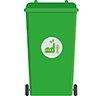
The green bin is used to collect all the other waste that cannot be composted or recycled. The contents of the green bin go to an energy recovery facility where it is used to generate electricity.
Every household is provided with a green bin for non-hazardous household waste.
What you should put in the Green Bin
What you should NOT put in the Green Bin. (They can be taken to the Household Waste Recycling Centre (Tip))
Fluorescent tubes
Guidelines for collection of the Green Bin
To report a missed bin collection, lost or damaged bin you can report it online 24/7.
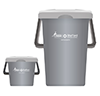 The grey kitchen caddy is used to collect your food waste, this is then bagged and placed in the kerbside caddy and collected weekly.
The contents of the caddy goes to an anaerobic digestion plant to produce bio gas, which is used to generate heat and electricity for National Grid and bio-fertiliser, which is used on local farms.
What you should put in the Grey Caddy
What you should NOT put in the Grey Caddy
Guidelines for collection of the Grey Caddy
Visit the Food Waste Section to find out more.
To report a missed bin collection, lost or damaged bin you can report it online 24/7.
Below are some common asked questions in regards to the waste and recycling collection service.
Why are we stopping residents from disposing of food waste with their garden waste?
There are a number of reasons, in brief they are:
Do other local Councils collect food waste only in the normal household waste bin?
Yes, Lichfield, Tamworth, South Staffordshire and Stafford Borough Councils all collect their residents food waste with their general waste and do not compost it.
Why is the Council still sending general and now food waste to landfill?
We are not. Since Oct 2013 general waste from across Staffordshire, including our Councils, has been disposed of by incineration at a plant in Staffordshire and used to create energy
Why doesn’t the Council do more to help the environment?
We try to reuse, recycle or recover as much as we can from the waste our residents create.
How does Cannock Chase Council compare to other Councils across the country?
Cannock Chase Council along with most other Councils across Staffordshire is in the top 25% of Councils across England for its recycling performance.
Why does the Council keep changing the waste service?
It doesn’t, the last large scale improvement of the waste service came in 2010 with the introduction of wheeled bins for dry recycling.
How much garden and food waste does the Council dispose of each year?
On average the Council disposes of around 9,000 Tonnes per year.
How much food waste does the Council dispose of each year as part of its garden and food waste collection service?
The Council estimates that only between 10-12% of its total garden and food collection is made up of food waste.
How much more expensive is it to dispose of mixed garden and food waste than just garden waste?
It costs over double the amount to dispose of mixed garden and food waste than garden waste alone per tonne.
Why is it so much more expensive?
Because of animal by-products mixed garden and food waste has to be disposed of in a much more controlled environment at controlled temperatures and cannot be initially allowed to rot away naturally as garden waste alone can.
What options are there for disposing of food waste?
Food waste could be disposed of by using the general (green) bin or garden and food (brown) bin in the past. But now due to the cost and the low amounts of food waste being disposed of the Council cannot justify the expense of disposing of mixed garden and food waste.
What if I get maggots and flies?
Maggots and flies can be kept to a minimum by wrapping food waste in waste /news paper or small waste bags such as pedal bin liners.
Can I compost my food waste at home?
Yes you can, the Council’s website has some hints and tips on home composting and the Council may even provide you with a free composter.
Why is it so important to get the right things in the right bin?
Bins that are contaminated cannot be recycled. If they are added to a recycling load the whole load of between 8-10 Tonnes of good recycling may be rejected at the disposal point. It may also have to be sent to landfill as at that point it is no longer classed as domestic but commercial waste.
What if residents get it wrong?
If a resident gets it wrong their bin will be tagged and will be left un-emptied. They will be required to remove the contamination before the bin will be emptied on the next collection day.
What if residents continually get it wrong?
While the provision of a general waste collection is a statutory requirement, the provision of dry recycling and garden waste collections are not and therefore can be removed by the Council if it considers a resident is not using them correctly.
Does the Council have any legal powers in relations to waste and recycling?
Yes, Under Section 46 of the Environmental Protection Act 1990 the Council has the power to decide the type of service provision it provides and specify how it should be used by residents.
How do I know what goes into what bin?
The Council uses a number of methods to help its residents identify what items go into what bin including:
What are the top 5 contaminators of dry recycling?
In no particular order they are:
Can I recycle my old clothes, textiles and shoes, in my blue bin with my other dry recycling?
Unfortunately, the Councils materials recycling facility can not take clothing, textiles or shoes. They require a different process to be sorted and can become contaminated by other recycling if mixed; making them un-reusable. Clothing, textiles and shoes can however all be recycled (along with other products such as small waste electrical and electronic goods) at your Local Recycling Centres at many supermarkets and carparks across the district or at the Household Waste and Recycling Centres (HWRC’s) in Cannock or Rugeley.

The household waste and recycling centres are operated by Staffordshire County Council. Locations and details can be found by clicking on the following link HWRC webpage