Once your bins have been emptied the contents go to different facilities to be processed. Your waste helps to produce electricity, fertiliser, compost and is recycled to create new products.
What happens to the contents of my blue bag and blue bin after collection?
We collect recycling separately, card and paper in a blue bag and plastic bottles, tubs, trays, tins, cans and glass items in a blue bin.
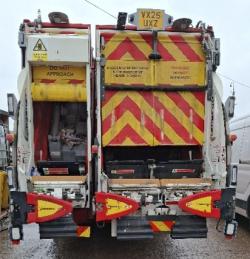
The householder plays an important role in this process as they are the first link in the chain that turns household waste into usable resources. It is therefore very important that at this first stage the right items are put into the recycling bin. Although there is only one lorry for the blue bin and blue bag, the lorry is separated into two compartments. The smaller section is where your blue bag is emptied, keeping the contents separate to the blue bin.
If the wrong items such as food waste, nappies, garden waste or cat litter, are put into the blue bin this could contaminate the other correct materials and the whole load could be rejected.
How is the recycling sorted?
After the recyclable materials have been tipped onto the tipping floor from the lorry they are scooped up and placed onto a conveyor belt. As the conveyor belt travels through the plant, different technologies are used to remove each recyclable material.
Blue Bag
The blue bag contents don’t have to be sorted as they are already separate, keeping paper and cardboard separate helps to produce a higher quality product.
Blue Bin
Blue bin contents go to a state of the art recycling facility in Aldridge, Walsall, where they are mechanically sorted from one belt to separate ones.
- Glass is broken up and sieved out to a separate belt.
- Metal is removed by a magnet (if magnetic) or electric charge that throws items onto another belt.
- Plastic is fired off using an air jet. As the plastics travel along the belt a scanner is set to recognise each plastic, each type of plastic reflects light at a different wavelength. When the scanner detects one it fires it off the belt onto another.
Green Bin
Green bin contents go to Veolia’s incineration plant at Four Ashes, Wolverhampton. The Plant is an Energy Recovery Facility (ERF), waste that cannot be recycled or composted is incinerated. The steam from this turns a generator which in turn creates electricity for the National Grid, the leftover ash is turned into an aggregate that can be used to make roads. The gasses produced go through a filter before being released so are completely safe.
Follow the link to see the plant in action. https://www.youtube.com/watch?v=hh2i465TyJs
Brown Bin
Brown bin contents is delivered to Bloomfields, Huntington. A method called Windrows is used, laying the waste out in rows and turned periodically naturally breaking down producing a nutrient rich compost. We do not receive any income from the onward sale of the compost.
Grey Food Caddies
Grey Caddy contents are taken to Biffa’s Anaerobic digestion Plant next to the Recycling Centre in Cannock. Your food waste is broken down by micro-organisms, this creates bio gas which is used to generate heat and electricity for the National Grid. A bio-fertiliser is also produced, this is rich in nutrients and used as a liquid fertiliser on local farmers fields.
Ever wondered what happens to your food waste once it's collected from your kerbside? Watch our short video to find out more about the food waste recycling service, how it works, and the journey your food waste takes after collection. From helping to reduce the amount of waste sent for disposal to creating valuable resources such as renewable energy and fertiliser, the video provides an easy-to-understand overview of the positive difference food waste recycling can make for our environment and local communities.
Watch the video to learn more.